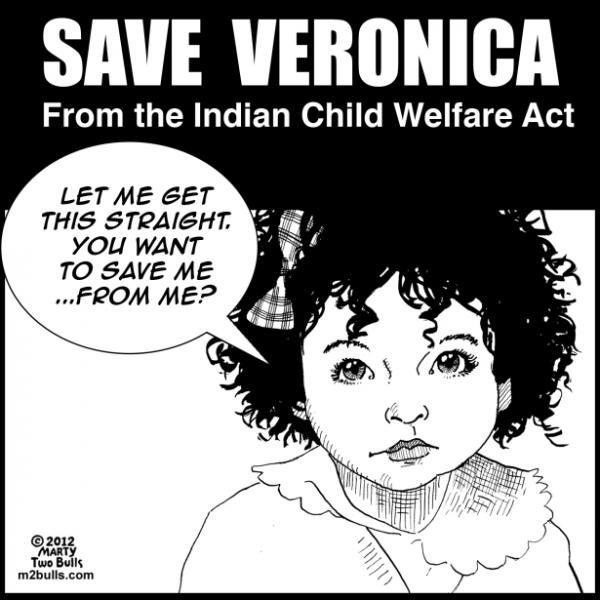
The Indian Child Welfare Act of 1978 (ICWA), which establishes federal standards for state-court child custody proceedings involving Indian children, was enacted to address "the consequences . . . of abusive child welfare practices that [separated] Indian children from their families and tribes through adoption or foster care placement, usually in non-Indian homes," Mississippi Band of Choctaw Indians v. Holyfield, 490 U. S. 30, 32. As relevant here, the ICWA bars involuntary termination of a parent's rights in the absence of a heightened showing that serious harm to the Indian child is likely to result from the parent's "continued custody" of the child, 25 U. S. C. §1912(f); conditions involuntary termination of parental rights with respect to an Indian child on a showing that remedial efforts have been made to prevent the "breakup of the Indian family," §1912(d); and provides placement preferences for the adoption of Indian children to members of the child's extended family, other members of the Indian child's tribe, and other Indian families, §1915(a).
While Birth Mother was pregnant with Biological Father's child, their relationship ended and Biological Father (a member of the Cherokee Nation) agreed to relinquish his parental rights. Birth Mother put Baby Girl up for adoption through a private adoption agency and selected Adoptive Couple, non-Indians living in South Carolina. For the duration of the pregnancy and the first four months after Baby Girl's birth, Biological Father provided no financial assistance to Birth Mother or Baby Girl. About four months after Baby Girl's birth, Adoptive Couple served Biological Father with notice of the pending adoption. In the adoption proceedings, Biological Father sought custody and stated that he did not consent to the adoption. Following a trial, which took place when Baby Girl was two years old, the South Carolina Family Court denied Adoptive Couple's adoption petition and awarded custody to Biological Father. At the age of 27 months, Baby Girl was handed over to Biological Father, whom she had never met. The State Supreme Court affirmed, concluding that the ICWA applied because the child custody proceeding related to an Indian child; that Biological Father was a "parent" under the ICWA; that §§1912(d) and (f) barred the termination of his parental rights; and that had his rights been terminated, §1915(a)'s adoptionplacement preferences would have applied.
Held:
1. Assuming for the sake of argument that Biological Father is a "parent" under the ICWA, neither §1912(f) nor §1912(d) bars the termination of his parental rights. Pp. 6-14.
(a) Section 1912(f) conditions the involuntary termination of parental rights on a heightened showing regarding the merits of the parent's "continued custody of the child." The adjective "continued" plainly refers to a pre-existing state under ordinary dictionary definitions. The phrase "continued custody" thus refers to custody that a parent already has (or at least had at some point in the past). As a result, §1912(f) does not apply where the Indian parent never had custody of the Indian child. This reading comports with the statutory text, which demonstrates that the ICWA was designed primarily to counteract the unwarranted removal of Indian children from Indian families. See §1901(4). But the ICWA's primary goal is not implicated when an Indian child's adoption is voluntarily and lawfully initiated by a non-Indian parent with sole custodial rights. Nonbinding guidelines issued by the Bureau of Indian Affairs (BIA) demonstrate that the BIA envisioned that §1912(f)'s standard would apply only to termination of a custodial parent's rights. Under this reading, Biological Father should not have been able to invoke §1912(f) in this case because he had never had legal or physical custody of Baby Girl as of the time of the adoption proceedings. Pp. 7-11.
(b) Section §1912(d) conditions an involuntary termination of parental rights with respect to an Indian child on a showing "that active efforts have been made to provide remedial services . . . designed to prevent the breakup of the Indian family and that these efforts have proved unsuccessful." Consistent with this text, §1912(d) applies only when an Indian family's "breakup" would be precipitated by terminating parental rights. The term "breakup" refers in this context to "[t]he discontinuance of a relationship," American Heritage Dictionary 235 (3d ed. 1992), or "an ending as an effective entity," Webster's Third New International Dictionary 273 (1961). But when an Indian parent abandons an Indian child prior to birth and that child has never been in the Indian parent's legal or physical custody, there is no "relationship" to be "discontinu[ed]" and no "effective entity" to be "end[ed]" by terminating the Indian parent's rights. In such a situation, the "breakup of the Indian family" has long since occurred, and §1912(d) is inapplicable. This interpretation is consistent with the explicit congressional purpose of setting certain "standards for the removal of Indian children from their families," §1902, and with BIA Guidelines. Section 1912(d)'s proximity to §§1912(e) and (f), which both condition the outcome of proceedings on the merits of an Indian child's "continued custody" with his parent, strongly suggests that the phrase "breakup of the Indian family" should be read in harmony with the "continued custody" requirement. Pp. 11-14.
2. Section 1915(a)'s adoption-placement preferences are inapplicable in cases where no alternative party has formally sought to adopt the child. No party other than Adoptive Couple sought to adopt Baby Girl in the Family Court or the South Carolina Supreme Court. Biological Father is not covered by §1915(a) because he did not seek to adopt Baby Girl; instead, he argued that his parental rights should not be terminated in the first place. And custody was never sought by Baby Girl's paternal grandparents, other members of the Cherokee Nation, or other Indian families. Pp. 14-16.
398 S. C. 625, 731 S. E. 2d 550, reversed and remanded.
Alito, J., delivered the opinion of the Court, in which Roberts, C. J., and Kennedy, Thomas, and Breyer, JJ., joined. Thomas, J., and Breyer, J., filed concurring opinions. Scalia, J., filed a dissenting opinion. Sotomayor, J., filed a dissenting opinion, in which Ginsburg and Kagan, JJ., joined, and in which Scalia, J., joined in part.