Introduction:
Throughout history, mankind has known one constant: war. Those who led men into battle in olden times were different from the leaders of today, frequently leading from the front. In ancient times, loyalty to a specific general was often all that kept an army intact. The generals that inspired the most loyalty frequently became rulers, if their own lords let them live long enough. After all, when the army follows the orders of one man, what other man can face him?
With that in mind, I’ve tried to be fair in these ratings. It’s truly impossible to compare eras – weaponry advanced, statecraft and politics changed, people’s loyalty became tied more to national identity, and on and on. There are, however, some things which all great generals must display. The factors I’ve tried to keep in mind are strategic (long term) and tactical (short term) fighting acumen, innovation on and off the battlefield, an ability to instill trust in the men and the leadership, and of course, wins. In a few cases, there were cuts from this list made because a general, despite apparent brilliance on the battlefield, lost a war. By way of further introduction, I’d like to discuss some of these near misses; the ones to whom our collective emotional ties are strongest.
Robert E. Lee
The hardest one to leave off the list, Lee commanded the Confederate Army in the Civil War against a better armed, better funded, better supplied and numerically superior force. No historian would deny Lee’s tactical genius. His strategic decisions, though, were at times questionable. It is inarguable that Lee made the single worst blunder of the entire war in going to Gettysburg and ordering the infamous “Pickett’s Charge” across a mile of open ground.
Gettysburg, of course, was Lee’s second foray into Union territory. The disastrous Antietam offensive showed clearly that Lee would have a hard time taking the fight to the North as he wished. That Lee would again forfeit his greatest strategic advantage – the ability to fight a defensive campaign – and would do so against the advice of his most trusted staff, shows that Lee’s grasp of how to win the war was not nearly equal to his grasp of how to win a battle. These two unmitigated disasters resulted in the bloodiest single day of fighting in U.S. history and the most casualties in one battle in U.S. history, respectively.
Lee had other advantages besides the mostly defensive nature of the war. The majority of the great martial minds of the time were Southerners. More of the top graduates out of the Virginia Military Institute, The Citadel and the United States Military Academy joined the Confederacy than the Union, including Lee himself and “Old Stonewall,” Thomas Jackson.
The flipside of this is that the Union was saddled with less competent generals. Every time the Union won a major victory (like the two aforementioned), the Commander of the Army of the Potomac failed to follow it up. Meade, Hooker, Burnside and McClellan all bungled away chances to put the Confederacy away through their inaction.
In the end, Lee must be left off this list chiefly because he was beaten soundly by the Union’s greatest commander… but that is a discussion for later.
George S. Patton
Truly an amazing man, Patton was unquestionably a great general. His skill in outmaneuvering respected tactician Erwin Rommel in Africa won him a greater command post in the eventual Allied victory in World War II. Prior to that, Patton was an innovator in the field of tank tactics and actual tank mechanics. Patton’s throwback style of leading from the front set him apart from his contemporaries and earns him serious manliness points. It is Patton’s relationship with and influence on another man on this list that ultimately keeps him off – not a slight of Patton, by any means, but recognition of the talents of our #10.
Douglas MacArthur
Supreme Allied Commander of the Pacific Theater during World War II, MacArthur led the primarily U.S. forces “island hopping” towards Japan. This successful but costly strategy was eventually rendered moot by the development of the atomic bomb. In Korea, MacArthur masterminded the audacious Inchon campaign, leading to the re-taking of Seoul. Clearly, MacArthur had a good grasp of tactics… but a better grasp of P.R. is why we remember MacArthur so well today. From publicly issuing his famous vow to return onward, MacArthur played the press brilliantly for the rest of his career. He even re-staged his re-landing in the Philippines so that camera crews could capture the event. Like Patton, MacArthur was the subject of a Hollywood movie. There end the similarities. Patton was portrayed as a courageous soldier but a man with flaws, whereas MacArthur was lionized as the savior of mankind. For these reasons, public perception of MacArthur’s greatness is somewhat inflated.
Others
There are no generals of the Crusades on this list. They were remarkably shortsighted in their approaches and frequently underachieved due to internal bickering. Samurai culture emphasized a style of fighting that didn’t need an effective high command, Nobunaga had guns that nobody else did, and Hideyoshi lost to 700 Koreans, so there aren't a ton of Asians on the list. There are no Athenians or Spartans on this list. Despite Leonidas’s noble stand at Thermopylae, sacrificing your best leader to the cause is a poor strategic decision. There are no names from the brutal conquests of the early American times. Annihilating inferior numbers while armed with vastly superior technology is not greatness. That said, on to the rankings.
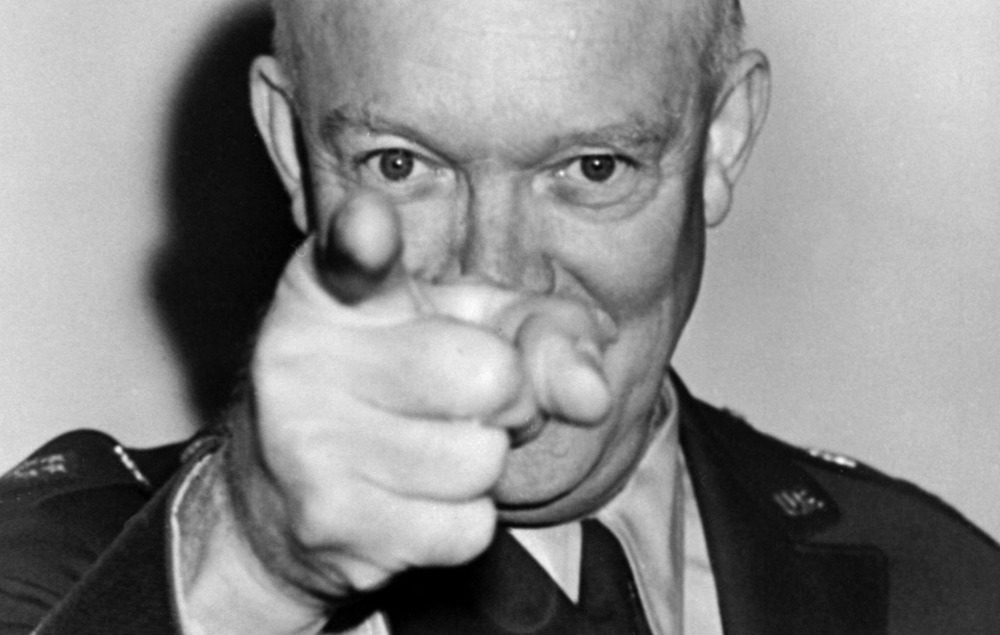
#10 – Dwight D. Eisenhower
Eisenhower spent most of his career as a staff officer. He never saw action in World War I. He spent more time in school than on the battlefield. In fact, he really only ever had one stage on which to demonstrate his prowess, but what a stage: Eisenhower was the Supreme Allied Commander, European Theater, when the Axis powers were ultimately defeated in World War II.
Raised to be a scholar and an athlete in Kansas, Eisenhower gained admission to the United States Military Academy in 1911. At West Point, Eisenhower was part of a class that became legendary, graduating with Omar Bradley, James A. Van Fleet, and Joseph T. McNarney. Eisenhower gained a reputation as someone who easily facilitated group cohesion, a skill which would serve him well for the rest of his life.
In the early stages of World War I, the Army underwent rapid expansion and Eisenhower soon found himself a captain. In 1918, he was made a temporary Lieutenant Colonel. He never saw the front in the War, spending most of his time training tankers in Gettysburg. This experience led him to George S. Patton, and the two became lifelong friends. Patton had a great influence over Eisenhower, convincing him of the importance of constantly studying tactics. The two future generals were well prepared when they were called upon to further their Army educations.
After the War, Eisenhower was given a promotion to regular Army major, a rank which he held for 16 long years. During the long stretch of peacetime downsizing, Eisenhower continued to excel at the various staff duties assigned him and eventually met another influential mentor, General Fox Conner. Conner introduced Eisenhower to various works of philosophy and laid the groundwork for Ike’s success in Europe by convincing Eisenhower that the Versailles Treaty ensured war within 30 years. Eventually, Ike attended Command and General Staff School, graduating at the top of his class. This led to the Army War College and the Army Industrial College.
In 1930, Eisenhower became special assistant to then Chief of Staff Douglas MacArthur. MacArthur called Ike “the best staff officer in the Army,” possibly because Eisenhower not only wrote his speeches, but also lobbied Congress on his behalf and prepared his stellar annual reports. Eisenhower also did detailed studies of the interrelationship of industry and military might.
Throughout the ‘30s, Ike continued to surpass all expectations of him to the point that when Pearl Harbor was bombed, Lt. General George Marshall gave Eisenhower full authority in his sphere. “I must have assistants who will solve their own problems and tell me later what they have done,” said Marshall.
Eisenhower soon became chief of the War Plans division of the Army, the branch responsible for all strategic decisions. In February of 1942, he drafted a brilliant document stressing that the Allies needed to focus on what they needed, rather than the many things they desired, to secure victory. This paper kept the Allies focused on Germany as the most immediate threat and helped outline the necessary steps to overcome the Nazis.
In due course, Eisenhower was sent to London as Commanding General, European Theater of the American Forces. He was America’s chief liaison with the British, a capacity at which he shined, and was responsible for marshaling the resources necessary to carry out a campaign. In November of 1942, when Operation TORCH was launched, Eisenhower was Commander in Chief, Allied Forces for the op. This position placed him in authority over senior, more experienced, higher ranking officers in both his own service (including his friend Patton) and the British Army. This was Eisenhower’s first real command action. He used the early sorties as a testing ground for equipment, learning what worked and what didn't, and at the same time learned how to handle his contentious multi-national staff – an assignment previously unknown in modern warfare.
After successfully coordinating his various forces in putting down the Vichy Regime, Rommel, and the Italians, Eisenhower was retained as Supreme Allied Commander for Operation OVERLORD. OVERLORD’s directive read “You will enter the continent of Europe and, in conjunction with the other Allied Nations, undertake operations aimed at the heart of Germany and the destruction of her Armed Forces.” This made OVERLORD clearly the climactic op of the entire War. Accordingly, Eisenhower used his role as Supreme Allied Commander to take control of every aspect of the plan that took more smarts than the average Orangutan possesses. He allowed all to voice their opinions, then assured them that his way was the best way, and that was the way it would be done.
D-Day, of course, kicked off Operation OVERLORD successfully. The Allies gained the beachhead, killed the Nazis, freed the Jews, and won the War – all following Ike’s plans and orders. But Eisenhower’s story continued.
After the War, Eisenhower became president of Columbia University, a position he retired from to become the first Supreme Commander of NATO. In 1952, Ike won a U.S. presidential election. Shortly after taking office, he withdrew our forces from Korea. Dedicated to peace, Eisenhower negotiated with the Soviet Union… but forced concessions from them larger than those he granted. At home, Eisenhower focused primarily on keeping a balanced budget and also created NASA.
Years of training leading to ultimate success strategically and tactically combine to put Eisenhower on this list. He then rode his success to further personal power as U.S. president, and wielded the bully pulpit to great effect in international relations. Despite some weaknesses with somewhat leftist policies at home, he kept a balanced budget, welcomed our 49th and 50th states, and created a space exploration program. Truly a great commander, Eisenhower definitely earned his place on this list.