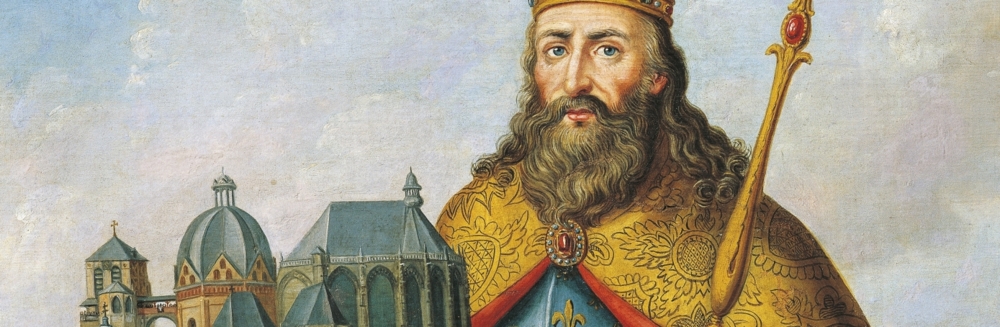
#5: Charlemagne
aaaaa
The grandson of a famous general, Charles Martel (The Hammer), Charles I became the first Emperor of the Holy Roman Empire because of his military ability, his devotion to the church, and his forward thinking social policy. Both the year and place of his birth are shrouded in mystery, but his impact on history is certainly not. Charles was by all accounts a physically imposing specimen, some six feet four inches in height, with prodigious strength and manly appetites to match. These qualities made him an excellent leader from the front – he killed more enemies than most of his other soldiers – and this in turn made him a very popular commander. These qualities brought Charlemagne to dominance over most of France, Germany, Italy, the Netherlands, Denmark and Austria as well as portions of Spain and Hungary.
Charles’s father, Pepin the Short, was invested with great rank due to the exploits of his own father, Charles Martel, who halted the advance of the Muslim horde into Europe from Spain. Pepin called on Pope Zachary to invest his son, Charles, with the royal distinction. Stephen III traveled across the Alps from Rome into modern Germany to anoint with oil Pepin (making him true king), Charles, and Pepin’s other son Carloman. This official act paved the way for Charles’s accession and assured his lifelong devotion to the Church.
After the death of Pepin, Charles and Carloman ascended jointly to the throne, each ruling half of his father’s kingdom. Charles recognized the need for expansion to protect his people from marauding barbarians and set out to complete his father’s mission of subjugating the Aquitanians. Charles was also motivated by a desire to bring order and stability to Europe as a whole, using Catholicism as his primary diplomatic weapon. This strong bond between church and military dominance was unlike any seen in Europe before or since, although it served as a model for the second Holy Roman Empire.
Carloman, on the other hand, died of illness after just three years of rule. Charles was left with the entire kingdom, proclaimed as leader of all the Franks by popular outcry. By that time, there was another new pope in place, Hadrian, who saw the advantage Charles’s strong commitment to faith could give. After entreaties from the pontiff, Charles proceeded to wage war with the Lombards. Pepin had also attacked the Lombards, ostensibly to liberate the church’s land and property from them. Pepin took some hostages and went home happy. Charles, on the other hand, laid siege to the Lombards’ important cities and banished all their rulers. Shortly, he was the ruler of Italy.
After subjugating Italy, Charles turned his attention to the German tribe of the Saxons. These Saxons were frequent marauders and raiders of Frankish lands, and Charles wasn’t going to stand for it any more. All accounts are that the Franks generally won these engagements and frequently received heartfelt capitulations from the Saxons, only for the raids to start again. Beginning in 772, Charles killed at least two Saxon leaders and converted two others at the sword, but the Saxons did not submit entirely until 804. During the vast majority of that time, Charlemagne was the acknowledged liege of Saxony. These constant struggles over a 30-year period didn’t stop Charles from expanding in other directions, though.
Charles’s next campaign brought him into Spain. His father Pepin had already brought the Gascons under Frankish rule (769), so Charles had a suitable area to launch a campaign from. In 778, he took Pamplona and drove as far as Roncesvalles, driving Muslims and Basques from their territory. By 795 he had grown all the way to Tortosa, about 50 land miles further down the coast from Barcelona.
From this point, Charles proceeded to subdue every major tribe of Germany, Demark, and the surrounding regions. His most vicious battles were fought with the Huns, who were still much-feared warriors at the time. Charles’s success on fields of battle was so monotonously consistent that by 1796, tribes were committing to him and converting to Christianity before he devised plans of conquering them.
In 800, Charles was in Rome during the modern holiday season. The Romans had removed the pope’s eyes and tongue, and the pontiff appealed to Charles for relief. Charles, of course, drove the Romans out of the church’s territory and executed most of them. On Christmas day, the king was knelt in prayer in St. Peter’s Basilica when Pope Leo III stole up behind him and placed a magnificent golden crown on his brow. From that point forward, Charles was known as the Holy Roman Emperor, Augustus. Popular legend holds that Charles had no advance knowledge of the coronation, but most serious historians think it implausible at best the Leo could have acted without the King’s express consent.
By 804, Charles had finished campaigning. He had doubled the size of his father’s already large country and was ready to devote himself to making it better. Truly the first Renaissance man, Charles had some very modern ideas for his government. The chronique.com passage below states it as succinctly as possible:
“Charlemagne struggled to protect a free peasantry against spreading serfdom… The King’s own estates… were the chief source of the royal revenue. For the care of these lands he issued a Capitulare de villis astonishingly detailed, and revealing his careful scrutiny of all state income and expense. Forests, wastelands, highways, ports, and all mineral subsoil resources were the property of the state. Every encouragement was given to such commerce as survived; the fairs were protected, weights and measures and prices were regulated, tolls were moderated, speculation in futures was checked, roads and bridges were built or repaired, a great span was thrown across the Rhine at Mainz, waterways were kept open, and a canal was planned to connect the Rhine and the Danube, and thereby the North with the Black Sea. A stable currency was maintained... He established a system of poor relief, taxed the nobles and the clergy to pay its costs, and then made mendicancy a crime.”
Charles established free Catholic schools for the public and incited the church to make the people literate. He also held gatherings of landowners, appointed citizens to important jobs on a rotating basis, and traveled to the various parts of his domain to hear petitioners. He had many wives, making a mockery of the marital ideals of the church he championed. Eight of his children were recognized as legitimate. Toward the end of his life, Charles began to waste away. Still the Emperor continued to hunt every autumn. In January of 814, though, Charles took ill and died. The final act of Charlemagne to be witnessed was receiving the Holy Communion. His tomb was inscribed “In this tomb lies the body of Charles, the Great and Orthodox Emperor, who gloriously extended the kingdom of the Franks, and reigned prosperously for forty-seven years. He died at the age of seventy, in the year of our Lord 814, the 7th Indiction, on the 28th day of January.” It was only upon his death that he received the appellation Charlemagne, meaning of course “Charles the Great.”
Like so many great conquerors, Charlemagne’s empire did not long survive him. Lacking a sufficient personality to take the throne of such a vast territory, the realm was eventually divided into three between his grandsons. His shadow was long, though. The second Holy Roman Emperor was created in the image of the first, encompassing about two-thirds of the land mass. We still use many elements of government that he pioneered. Statuary, art and poetry from and of the time have come down through the ages, and the Song of Roland is the official epic poem of France. It was from Charlemagne that Henry VIII inherited the title “Defender of the Faith.” It was because of Charlemagne that the Catholic Church was able to dominate Europe so thoroughly and for so long. Commonly called the greatest medieval king, Charles definitely merits the title.