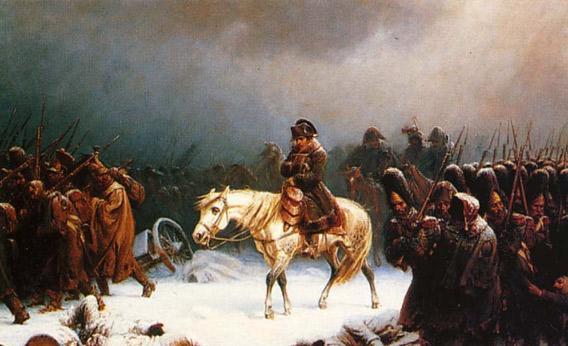
#6 – Napoleon Bonaparte
What my enemies call a general peace is my destruction. What I call peace is merely the disarmament of my enemies. Am I not more moderate than they? –Napoleon Bonaparte
Napoleon is the second (and last) general on this list that ultimately went down in defeat. The French Emperor in the early 1800s, Napoleon began as an artillery officer and used his military genius to become the dominant figure in the world. His incessantly strategic mind eventually undid him, as Napoleon seemed incapable of living in a Europe at peace. His final defeat came, of course, at Waterloo when Field Marshall Emmanuel de Grouchy failed to bring his rearguard up in time to intercept the Prussian forces coming to reinforce the British under the Duke of Wellington, Arthur Wellesley.
Napoleon was born in Corsica, an island claimed variously by France, Spain and Italy during various periods of history. He was from a minor noble family, and was filled with a desire to prove his worth. Toward that end, the young Bonaparte became an officer in the French army. With all hell breaking loose in France – there was a revolution running simultaneously with a war with four other countries – Napoleon was able to draw serious attention from the top brass as a captain in 1793. At the siege of Toulon, Napoleon devised the plan by which the British were driven out. He used his artillery to devastate the enemy on the heights of Fort Mulgrave, then moved in and suppressed the town with artillery fire. Two days later, the British withdrew, ending a four month standoff. Four months after that, the captain was a brigadier general.
In 1795, Napoleon stopped an uprising in Paris with a “whiff of grapeshot” into the mass of rebels. This prompt and direct action gave him great favor with The Directory (France’s new government), and he was soon given command of the Army of Italy.
Napoleon was ordered in early 1796 into action in Italy, to take the Austrian attention away from the other French offensive in Germany. After keeping the Austrians tied up in Italy, Bonaparte was to reinforce the presumably victorious French army marching through Germany toward Austria. Deeming the plan impossible, Bonaparte decided instead to go for total victory in Italy.
During his maneuvers in Italy, Napoleon showed off all the tactics that would make him successful again and again. He consistently occupied the “central position” between two armies, allowing him to engage the weaker of the two first, then tackle the other at his leisure – also keeping the two forces from joining. He also embarked on several “manoeuvre sur les derrieres,” wide ranging movements by which he gained position on the enemy’s rear. Napoleon used this tactic more than 30 times in his career, almost unfailingly with spectacular results. Another tactic used by Napoleon was the “plan with branches,” in which his forces would move in 3 (or more) separate columns capable of diverging or converging quickly and at will.
He also employed his favorite tactic, the “strategic battle.” This called for Napoleon’s troops to engage the enemy in a frontal assault designed to bring the enemy’s reserves into the front, at which time a “masse de rupture” of artillery, infantry and cavalry would burst from a predetermined spot on the battlefield and rip a gaping hole in the enemy flank. More troops would then pour in through said hole and fuel a rout. The masse de rupture was an extension of Napoleon’s philosophy that war was won by having the most strength at the proper place.
Napoleon’s campaign in Italy was extremely successful, as he wiped out several larger forces and pinned down a huge number of troops in siege at Mantua. One attempt to relieve the city was ground to a halt within sight of Mantua’s walls. The French won a major engagement in November of 1796 (Arcole) with most of their soldiers malnourished and unshod.
In 1798, Napoleon landed in Egypt and began another campaign that would prove successful. He was nearly undone by the naval superiority of the British – something he would never overcome – but was able to rout the Mamelukes and the Ottomans in various actions. In fall of 1799, Napoleon returned home to Paris and seized the reins of power.
Napoleon’s first engagement as First Consul was nearly a disaster, but at the eleventh hour he was saved by reinforcements. The victory in this battle, at Marengo, led to an Armistice with the Austrians. By 1802 Napoleon had forced peace on his terms on the rest of Europe. Soon after he was crowned Emperor.
In 1805, Britain, Austria, Russia and Sweden formed the Third Coalition to fight against France. Napoleon moved his forces with his customary speed (far faster than the other guys) and outflanked the Austrian army at Ulm in southern Germany. Here Napoleon took some 30,000 captives, killed 10,000 and lost a mere 1,500 men. After his victory on October 20, Napoleon proclaimed, “Never has a victory been so complete and less costly.” Unfortunately, the following day brought the naval battle of Trafalgar, whose consequences were dire for the long-term health of the French Empire.
1805 also saw one of Napoleon’s most ingenious and important victories, at Austerlitz. The diminutive Emperor tricked the opposition into believing he had abandoned his dominant position on the Pratzen Heights preparatory to a retreat and enticed them into attacking his flanks. Repelling the flank attacks proved as simple as Napoleon thought it would, and his artillery emerged from the mist on the Heights and opened fire, to shattering effect. The battle turned into a race by the allies to get away, with many men and horses falling through the ice and drowning in the Satschan Lake. This victory put an end to the coalition, as the Austrians capitulated and the Russians retreated to the safety of Poland. Later French victories at Jena/Auerstadt and Friedland led to the Prussians and Russians suing for peace as well.
Around this time, late 1806 to early 1807, Bonaparte started to rely on overwhelming force and attrition tactics to win battle for him, rather than superior mobility and surprise. Not surprisingly, his battles became far more costly to win, especially since his strategy involved crushing enemy armies rather than the people’s will to fight. By the time of the Wagram campaign in 1809, Napoleonic battles were seeing single day casualties in the 40,000+ range.
In 1812, Bonaparte made his most infamously poor decision. He amassed an army of over 600,000 troops to invade Russia. The French force won the battles along the way, advancing to and occupying Moscow. The Russians, however, refused to give in, and Napoleon ordered his disastrous retreat from the Russian capital city. This was the beginning of the end of Napoleonic France. By the beginning of 1814, Napoleon was fighting another coalition with more than triple his numbers. The Allies were able to dictate the locations of the battles, and Bonaparte faced inevitable defeat and exile to the Isle of Elba.
In 1815, of course, the Emperor returned, for the “Hundred Days” which would mark his last entry in the history books. Hounded by Allied forces, Napoleon had little choice but to fight at Waterloo, which brought his time of ruling to an ignominious end.
By combining lightning mobility, multiple strikes, and a keen ability to fight the force of his choosing, Napoleon Bonaparte revolutionized the way wars were fought. Had he followed his own model, it is possible that the French Empire would be one of the dominant world powers today. His failure to grasp that destroying armies wasn’t enough to end people’s will to defeat him ultimately led to his defeat.