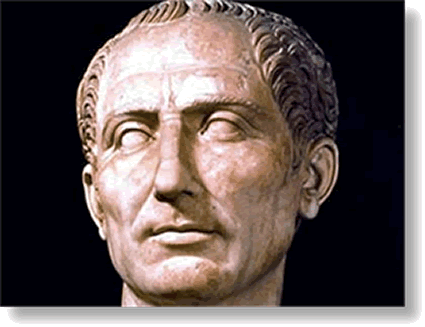
#4 – Gaius Julius Caesar
There were conquerors before and after Caesar who subjugated greater numbers of people. There were domains larger than his Roman lands. There were those who created nations from less. Caesar is special, though, for several reasons. He took over from within by winning the loyalty of the army. He won that loyalty by proving in battle that he was a brilliant tactician, rarely taking the worst of an engagement. In the campaigns that proved his great competence, he doubled the size of Rome. He then defied the Senate, the body that initially gave him his power, by re-entering Rome with his legions intact. After that he crushed an opposition force of Romans more than double the size of his own army. Following all this he was named dictator for life, but he didn’t hold the office long. Within a year of that appointment, the man whose name came to mean “emperor” was assassinated by his closest friends.
Caesar was born to a patrician family in 100 B.C. His family’s status was not envious at the time of his birth – patricians generally were less powerful than they had been, and the Julii family particularly was poor and downtrodden. Caesar set out to make a name for himself in the traditional patrician fashion: in politics.
When he was 18 years old, Caesar married for the first time. His choice of wife, Cornelia, identified him with the radical element of politics. Her father was a prominent member of the popular faction. Caesar’s uncle Marius would eventually lead an uprising of the popular faction against the Roman government. After Sulla defeated Marius and became dictator of Rome, he ordered Caesar to divorce Cornelia. When Caesar refused, he was obliged to go into exile as Sulla ordered his execution. Sulla eventually recanted the sentence against his better judgment, saying “I see in this man many Mariuses.”
In 81 B.C., Caesar convinced the king of Bithynia, Nicomedes IV, to lend Rome naval support for the war against Mytilene, a Greek state. His success in persuading the previously disagreeable king led to rumors of a homosexual relationship between the two. In 80 B.C., Caesar served as a soldier, distinguishing himself in the battle of Mytilene there by saving the life of a citizen.
Following Sulla’s death in 78 B.C., Caesar returned to Rome as a prosecutor. He began to make a name for himself as a great orator the following year when he began taking down Sulla’s corrupt lieutenants. In 75 B.C., while traveling to Greece to study oratory, Caesar was captured by pirates. The pirates wanted to demand 20 talents in ransom for the young lawyer, but Caesar insisted he was worth 50. He then was able to have the money brought to the pirates, promising them that he would have them all crucified when he was freed. He made good on the promise, although he had their throats cut to ease their suffering. The next year Caesar used the wealth he’d taken from the pirates to raise his own provincial army to defeat an invasion by Mithrindantes IV, an illegal action that saw no repercussions because he was aiding Rome.
Caesar held his first political office in 72 B.C. He was elected military tribune by the plebs, serving his term in the year of the consulate of Pompey and Crassus (Romans marked years by referring to the consuls for the year). In this capacity Caesar helped quell the slave rebellion led by Spartacus. In 69 B.C., Caesar had a landmark political year. His mother and wife both died, and Caesar used the platform of their funeral orations to praise Marius and his ideas – something that had been outlawed under Sulla. That same year Caesar left Rome to serve a term as quaestor in what is now Portugal.
As his career progressed, Caesar held a string of political offices. He was chief curator of the Appian Way, he was Curule Aedile – in which capacity he staged the largest gladiatorial games the city had ever seen – he was pontifex maximus, a religious position, and he served as praetor. He proved adept at detecting and aiding or avoiding plots as suited his needs. He formed friendships with the aforementioned Pompey and Crassus, the former a respected general, the latter a wealthy benefactor.
In 61 B.C., Caesar became proconsul of further Spain. In this capacity he subjugated several tribes of Spanish people and seized their silver mines. With this newfound wealth he repaid his mind-boggling debt in Rome (over 3300 talents) and gave large bonuses to all of his soldiers. For his success, Caesar was given a triumph, or great celebration of victory.
Returning to Rome in 60 B.C., Caesar used his influence with Pompey and Crassus to bring the two rivals together and form a pact with him to look out for each others’ interests. This was later deemed The First Triumvirate, as these three essentially shared rule of Rome from that point forward. With his new allies Caesar easily won election to the consulship for 59 B.C. Caesar had now achieved the highest political office in Rome at the age of 40, two years before the law allowed for it. He quickly used his popularity with the plebs to get a set of bills passed to allow farming in areas previously set aside for different purposes. He publicly embarrassed his co-consul, Bibulus, so severely that there are no more public records of Bibulus for the year of his consulship. Romans referred to 59 B.C. as “the year of Julius and Caesar.” Caesar also used his power as consul to give himself an unprecedented five-year proconsulship of Gaul. This would set the stage for Caesar to burn his name indelibly in the history books.
In 58 Caesar entered Gaul with several legions at his back. He befriended those Gallic tribes who wished Roman citizenship and crushed their German enemies. This took the whole campaigning season of 58. In 57, Caesar turned his attention to the Gallic tribes who openly opposed Roman influence. He succeeded in his Gallic campaigns by moving his troops faster than the enemy could anticipate and by taking routes that could not be predicted, thus proving that Rome had learned the lessons of Hannibal. By 55 B.C., he had put down all of these tribes and sailed a force to Britain. Although he would test the British shores again in 54, there was little Caesar could do to expand in that direction.
In 53 B.C., Caesar crushed a group of Germans under Ambiorix who were attempting to aid the Gauls in breaking free of Roman rule. The same year, the Arvernii produced a chieftain of great physical prowess and tactical awareness named Vercingetorix. Vercingetorix united all the tribes of Gaul in a rebellion against Caesar, and adapted Caesar’s own tactics against him. Vercingetorix was the only commander to ever defeat Caesar on the field, but Caesar was ultimately victorious at Alesia in the fall of 52. The surrender of Vercingetorix left the Gauls with no hope of throwing off the Roman yoke, and Caesar had nothing left to accomplish in Gaul militarily. He set about making overtures of friendship to the Gallic tribes, offering Roman citizenship and all the benefits thereof to the tribes who could demonstrate loyalty.
Meanwhile, Crassus was killed at the disastrous battle of Carrhae in 53. Pompey then aligned himself with the Optimate faction, Caesar’s enemies. This left Caesar in a precarious position politically, open to prosecution and possible execution for his “illegal” war in Gaul. Caesar tried to maintain his good public image by sending his carefully and masterfully constructed Commentary on the Gallic War ahead of him for publication in 51 B.C. He also tried to run for consul in absentia to preserve his legal status of “untouchable;” returning to Rome as a private citizen would have been tantamount to suicide.
Caesar began the march back to Rome with 10 legions at his back. In early 49 B.C., he reached the Rubicon River. This was the spot from which Caesar would have to proceed alone in order to avoid a civil war. According to legend, Caesar stopped and contemplated what action to take when an apparition playing a horn goaded his men across the stream. However it was decided, Caesar marched on Rome with his armies intact, fiercely loyal, and battle seasoned. The majority of Pompey’s forces were in Spain, so Pompey and the Senate fled the city, leaving it open for Caesar. Caesar was named dictator, the first of several times he would wear the title for only a brief period. In 48, he fought Pompey several times, defeating Pompey’s vastly larger forces for good at Pharsalus in Greece.
After defeating Pompey, Caesar put down revolts in Spain and Egypt. He gave pardons to most of his enemies. He befriended those who had most vociferously opposed him. He reformed tax laws, reduced corruption among officials and increased the well being of the average citizen tremendously. He fixed the calendar, which had long been changed at whim to suit politicians. Caesar’s biggest mistake came when he didn’t refuse an honor from the Egyptians and allowed himself to be worshipped as a God. Several members of the Senate took this as proof that his ambition had grown too great. On March 15, 44 B.C., the conspiracy against Caesar bore fruit, as he was stabbed to death on the Senate steps. He had been named Dictator for life less than three months prior.
Caesar was truly an amazing man. A great speaker and writer, well read, quite the politician, a good soldier and, clearly, a great general. Plutarch said that Caesar fought three million men, killing one million and capturing another million. Those are staggering numbers to even consider in that day and age, fighting on horseback with no saddle and ineffective bows, and on foot with swords and shields. To put it in perspective, the whole of western Europe didn’t suffer 1,000,000 battle deaths in all of the Crusades. He came, saw and conquered, indeed. His legacy went far beyond that, though, as he pulled Rome out of a downward spiral and kickstarted a new era of greatness that would be realized by his successors. Hail Caesar!