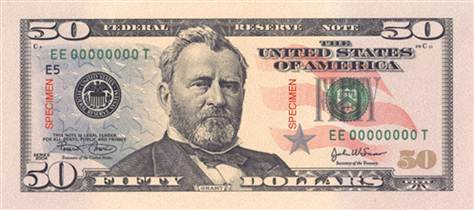
#8 - U.S. Grant
Often maligned for his public service after the war, frequently dismissed as less able than the Southern generals, and often regarded as inferior to his own subordinate, William T. Sherman, U.S. Grant gained his position on this list by proving himself the commander needed to lead the Union to victory in the Civil War. Grant’s troubles in life outside of wartime are well documented and much discussed, so this discussion will be limited to what made him great – his ability at war. Grant seemed to have only that one usefulness in his life, a trait which surely enhances his position here in the eighth spot.
Grant graduated low in his class at West Point, being 21st out of 39. This did not stop him from distinguishing himself in the Mexican War. He came under fire for the first time on May 8, 1846 at the battle of Palo Alto and afterwards, wrote in his journal “You want to know what my feelings were on the field of battle! I do not know that I felt any peculiar sensation. War seems much less terrible to persons engaged in it than to those who read of the battles... During that night I believe all slept as soundly on the ground at Palo Alto as if they had been in a palace. For my own part I don't think I even dreamed of battles.”
Later that same year, on September 21, Grant (a quartermaster at the time) defied orders to lead a charge in the battle of Monterey. Following his actions, he became the new regimental commander. Two days later, amid intense fighting, Grant volunteered for a dangerous courier assignment, literally hanging on to the side of his horse to present less of a target.
In San Cosme Garita, Grant gained notice from the top brass by placing a howitzer in the belfry of a church. This commanding position allowed Grant to lay down a withering field of fire, greatly contributing to the officials of Mexico City asking for surrender terms the following day.
In the years immediately following the Mexican War, Grant had far less exciting posts. During his time on the west coast, Grant became homesick for his family and the second son he’d never seen. Eventually, Grant resigned his post – on the same day he was promoted. He returned home to his family, and built their new home himself on a farm he named Hardscrabble. Things were not going well for the Grant family when war broke out.
After Fort Sumter, Grant had a hard time getting a commission in the Union Army, finally being made colonel of a regiment known for driving commanding officers crazy. Grant was ordered into action for the first time in July, 1861. He was sent to attack a company under the command of Thomas Harris in Florida, Missouri, but arrived at Harris’s position to find an empty camp. Said Grant of the incident: “As we approached the brow of the hill from which it was expected we could see Harris' camp, and possibly find his men ready formed to meet us, my heart kept getting higher and higher until it felt to me as though it was in my throat… the marks of a recent encampment were plainly visible, but the troops were gone. My heart resumed its place. It occurred to me at once that Harris had been as much afraid of me as I had been of him. This was a view of the question I had never taken before; but it was one I never forgot afterwards.”
Grant’s first major contribution to the Union cause came in September of that year, after Lincoln had promoted him to brigadier general. Rebel Leonidas Polk had violated the neutrality agreement of Kentucky by occupying Columbus. The day after hearing the news, and three days after Polk’s action, Grant occupied Paducah, preventing the Confederates from consolidating themselves in Kentucky. Still, Grant’s troops were used primarily as diversionary and defensive ones, a fact which rankled Grant. In January of 1862 he requested and received permission to mount an offensive in Tennessee. In a span of ten days, Grant took Forts Henry and Donelson, at both times demanding what would become his nickname: Unconditional Surrender. These victories bolstered flagging Northern confidence, providing evidence that generals were getting results. The day after Fort Donelson, Grant was promoted to major general.
These successes, though, led Grant to overconfidence entering his next major battle. Shiloh would change the tenor of the war, shocking both sides with its amazing casualty numbers, girding both camps for the horrors to come at places like Antietam and Gettysburg. Apparently, Grant was so busy planning his attack on the Confederates, he never stopped to consider that they would attack him first. At about 6:00 am on the morning of April 6 Grant was eating breakfast at a house a few miles from the battle when he heard cannon fire. He calmly turned to his officers and said “Gentlemen, the ball is in motion. Let’s be off.”
Arriving at the battle at approximately 8:00 am, Grant immediately took to the front lines, exhorting his mostly green troops to hold their ground. With their general leading the way and the expected reinforcements nowhere in sight, they tried, yielding one bloody inch at a time. Grant, who was lame at the time from a horse falling on his leg, was nearly shot three separate times during the day’s fighting. One bullet actually hit his scabbard. Still, he was confident that if he could hold out until the end of the day, he could smash the Confederates the following day, and that’s exactly what happened.
It is interesting to note that Sherman approached Grant the night of the sixth to advise retreat, but saw his commander’s face etched in stone and thought better of it. Instead, he offered “We’ve had the Devil’s own day haven’t we?” Grant’s reply was a perfect summation of his implacable attitude. “Yup. Whip ‘em tomorrow though.”
Sherman also displayed incredible personal valor at Shiloh, as one observer described: “dismounted, his arm in a sling, his hand bleeding, his horse dead, himself covered with dust, his face besmeared in powder and blood.” This was the figure leading the decisive Union charge – wounded and unhorsed.
Even though he won the battle, Grant came under severe fire for the number of casualties at Shiloh and was moved to a support role. Lincoln still thought highly of him, though. “I can't spare this man; he fights,” was the president’s assessment. As time went on and the magnitude of the Shiloh victory sunk in, more people came to Grant’s public defense, leading to him being placed in charge of Tennessee, with headquarters at Memphis. There Grant engaged in cat-and-mouse, now we’re here now we’re not game with Confederate forces, which had the good luck to engage Union troops where Grant wasn’t. They still achieved little. Meanwhile, McLellan was proving to be a truly incompetent commander in chief of Union forces.
On November 2, 1862, Grant began the campaign that truly made his reputation as a general, setting the key strategic city of Vicksburg as his goal. Grant’s initial attempts at Vicksburg ended in failure in December, but he headed back to Memphis with a valuable lesson. On his retreat Grant realized the never-ending bounty of the land around him, something he and Sherman would take into serious account later in the war.
Grant, undeterred as always, continued to make plans on Vicksburg, but the city was well defended. It was nearly impossible to get into proper position to attack, never mind actually taking it. The Confederates were not in a rush to lose such an important outpost. During this time, Grant began to receive some unfavorable publicity. Some generals were jealous of his rapid rise, some thought they could do better, some just didn’t like him. Lincoln sent a special investigator, Charles Dana, who found that Grant enjoyed nearly fanatical support from his troops. Dana also found Grant to be personally competent and ingenuous, all of which he relayed gushingly to Lincoln.
In April of 1863, the Confederacy was brimming with confidence that Vicksburg would stand as “the Gibraltar of the west.” Many on the Union side shared this view, and Grant’s most trusted subordinates, Sherman and James McPherson, advised their commander to withdraw to Memphis and regroup. Grant refused, telling Sherman “The country is already disheartened over the lack of success on the part of our armies… If we went back so far as Memphis it would discourage the people so much that the bases of supplies would be no use…” Then Grant put into action possibly the most daring attack of the entire war.
Since roundabout ways and backwater canals had proved no avail, Grant decided on the least expected course of action. He marched his troops directly downriver and crossed the Mississippi in range of the cities artillery defenses for a ground assault. Meanwhile, he had cavalry raiders tie up general Pemberton to keep the crossing unchallenged on the ground. Grant then ordered Benjamin Grierson to take his cavalry on a supply line raid to cut off and further distract the southerners. Grierson’s incredibly well orchestrated marauding led to Grant having an unopposed re-crossing to get back into position on April 30. Grant drove Pemberton’s forces before him back into Vicksburg, and set siege to the city. The garrison surrendered on Independence Day and 30,000 prisoners were taken. The Confederacy was effectively split in two, as the Union controlled the entire Mississippi River. Victory at Vicksburg came one day after the conclusion of Gettysburg, and the Union took the momentum of the war for good.
Union forces failed to follow up the Gettysburg victory so, in early 1864, Lincoln made Grant, his go-getter, the new commander in chief. The rest of the war was almost anticlimactic. Grant’s plan had Sherman heading East from Mississippi, waging total war (remember the lesson of the Vicksburg retreat), eventually leading to Sherman’s famed March to the Sea. Grant chased Lee through northern Virginia, inflicting casualties the South could no longer absorb. Inevitably, Lee surrendered. At the Appomattox Courthouse in Virginia he gave unconditional surrender of the Army of Northern Virginia. The war was over.
Grant went on to become a fairly undistinguished president, carried to electoral victory on the strength of his war record. He continued to show a lack of competence at life outside of war. He drank heavily, and was too trusting of his war colleagues. Nevertheless, without his major contributions in both the eastern and western theaters, the Union could not have won the war. He singlehandedly stalled the Copperhead movement in 1863 and delivered the goods that were thought undeliverable in Vicksburg. He continued to push forward at all times, refusing to follow the pattern of allowing the enemy to regroup established by his commander-in-chief predecessors. He won the Civil War, and so he has earned this spot.