#7 – Hannibal Barca
From the middle of the third century BC through the first half of the second, the emerging Roman Republic fought a series of wars with fading power Carthage for domination of the Mediterranean area. These wars, known as the Punic Wars, firmly established Rome as the dominant power in the Western world and marked the end of Carthage’s power. The most important of these three separate conflicts is undoubtedly the second, as Carthage had a brilliant commander intent on exacting revenge from the Romans for Carthage’s earlier defeat. This commander was Hannibal Barca.
Surely at this point you’re wondering why I have a general who lost a war on my list, given my previously articulated stance that winning is the most important criteria. There are a variety of mitigating factors in favor of Hannibal’s inclusion. First is that the Romans were clearly a superior naval power, which we will see was a major problem. Second is that the Romans offered more personal freedom to citizens than did Carthage, and thus was a more attractive ally for city states in Italy that Hannibal hoped to attract to Carthage’s banner (and later, Carthage’s African allies, the Numidians, who provided Rome with the cavalry needed to win the final confrontation). The third point helping Hannibal’s rating (but not, unfortunately, the Carthaginians) was that he was ordered by his rulers into what he knew was an unfavorable final battle, while his opponent, Publius Cornelius Scipio (Scipio Africanus), was able to act as he saw fit. The final reason Hannibal’s defeat doesn’t keep him from the list is Scipio Africanus himself, a general who would be number eleven were this a list of twenty.
Hannibal learned at an early age to hate the Romans, as he witnessed his father’s defeat in the First Punic War. Ingrained thereafter with a deep desire for revenge, Hannibal became the commander of the Carthaginian forces in Iberia (modern day Spain) in 221 BC. He immediately set about expanding Carthaginian power in the area, conquering many small city-states and winning valuable allies. In 219 BC, Hannibal captured the town of Saguntum after an eight-month siege, prompting the Romans to claim a treaty violation. Rome wanted Hannibal to surrender himself for judgment. Instead, he invaded Rome.
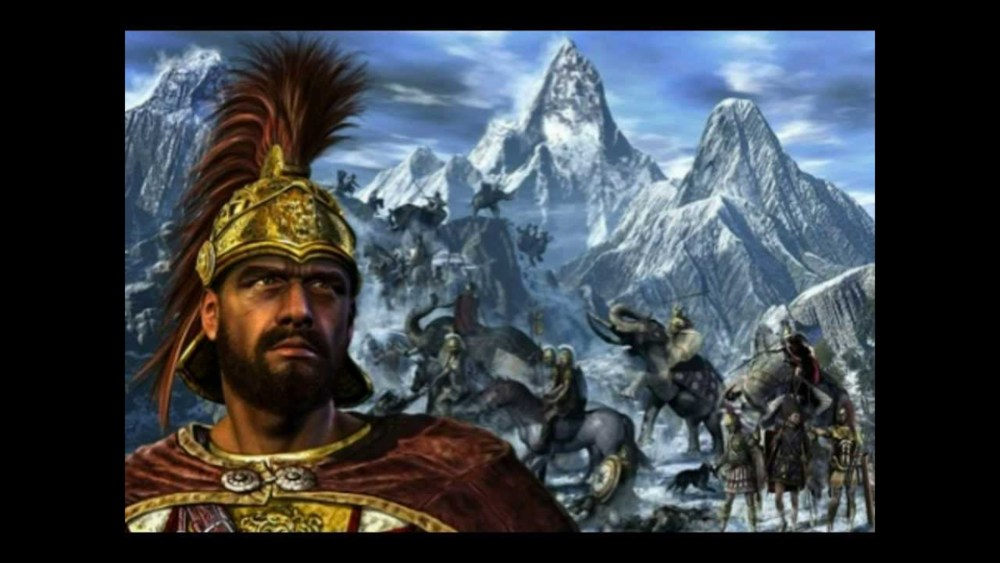
That same year, in his most famous action, Hannibal crossed the Pyrenees, the Rhone River and then the Alps with 50,000 infantry, 9,000 cavalry and a troop of 37 elephants. Nearly half of Hannibal’s troops didn’t complete the journey, but he received the desired result: he shocked the Romans by doing the “impossible.” He was in their territory far before they were ready for him, and was able to augment his army by recruiting Gallic troops. In October of 218, Hannibal had his first clash with Roman troops at the Ticinus River, delivering a defeat and near fatal wound to Publius Cornelius Scipio the elder, father of Scipio Africanus. This minor victory helped attract more Gauls to the Carthaginian standard, setting the stage for the first of Hannibal’s three most successful battles.
In December of 218, Hannibal had replenished his forces to the 30,000 troop mark. The Romans had an army of 40,000 tracking his movements under the elder Scipio and Tiberius Sempronius Longus. Hannibal sent out cavalry skirmishers to harass the Roman troops, who were across the Trebia River. Longus reacted as Hannibal anticipated, crossing the river to engage the seemingly inferior Carthaginian force. Hannibal was ready.
The freezing cold, soaking wet legionaries formed up with the river at their backs to mount an attack. The Carthaginian line was formed in Hannibal’s favored formation: infantry in the center with sling men, cavalry, and war elephants on the flanks. With their mobility concentrated on the outer edges, the Carthaginians quickly had the Romans surrounded on three sides. At that point, 2000 of Hannibal’s best cavalry led by his brother Mago emerged from their hiding place – an upstream ravine – and assaulted the Roman rear. The rout was complete, as the Romans lost numbers equal to the entire Carthaginian force (some 30,000+), while the Carthaginians lost about 5,000 men. Following this decisive victory, Hannibal spent the winter recruiting local troops and learning the local geography.
The Romans, meanwhile, deployed two consular armies to deal with Hannibal, the larger being led by Gaius Flaminius. What the consuls hadn’t planned on was Hannibal again achieving the impossible. He led is troops, 40,000 strong, over the Apennine mountains to the coast, then marched south to an “impassable” marsh surrounding the Arno River. Hannibal lost an eye to infection during the crossing of the marsh, but it was well worth the price. The bold maneuver put his army between Flaminius and Rome, and Flaminius came posthaste to catch him. Hannibal set up his men near Lake Trasimene to wait for Flaminius. The Carthaginian cavalry and skirmishers were well hidden, while the weaker infantry force camped on a hill visible from the lake, encouraging pursuit. As Flaminius led his troops through a narrow defile on the lake shore, all the elements of Hannibal’s army converged on the Romans, pushing many of them into the lake to drown. Trasimene was a total rout, called by many historians the greatest ambush of all time, with over 30,000 Romans being butchered to a mere 2,500 Carthaginians. Of the 10,000 Roman survivors, more than half surrendered to avoid death.
For a time after Trasimene, one Quintus Fabius Maximus, who advocated slowly chipping away at Hannibal without direct confrontation, led the Romans. In other words, Rome waged a campaign of guerrilla warfare against the invading force despite having vastly superior numerical strength. In July of 216, though, Hannibal captured a vital Roman supply depot, eliciting a swift response. A consular force of 80,000 infantry and 6,000 cavalry set out for Cannae, the scene of Hannibal’s most famous victory.
Hannibal used the formation outlined earlier, with his infantry (center) bulged outward toward the Romans. As the legions met the Carthaginian foot, they gained ground quickly. The Carthaginian bulge slowly reversed, drawing the Romans into a large bowl. With Hannibal’s brother Hasdrubal leading them, the Carthaginian cavalry on the left routed their Roman counterparts and swept around to the legions’ rear. The cavalry on the right soon followed suit. The devastation was immense, as the Carthaginians, with about half the troops, slaughtered the Romans wholesale. More than 50,000 Romans were lost (Bevin Alexander puts the number at 70,000), to only about 6,000 for Hannibal. Rome would never endure a greater disaster on the field of battle.
Hannibal continued to campaign in Rome for many years after, but was unable to receive consistent (or any!) reinforcements from Carthage due to Rome’s naval might. Hamstrung without siege equipment, Hannibal was also unable to take many of the cities that would have given him a greater power base to operate against Rome. Some cities did side with Carthage, though – notably Syracuse, whose famed inventor Archimedes died during Rome’s siege of the city.
In 210 BC, Rome finally started to hit back where it hurt. Scipio Africanus was dispatched to Iberia, where he was able to win many inspired victories against many commanders not named Hannibal Barca. Romans, especially Cato the Elder, wanted Scipio to attack Hannibal directly, as he was still in southern Italy. Scipio, though, knew better. Using Hannibal’s own tactics as his guide, he cut off Carthaginian supply lines and recaptured important ports. Then he marched on Carthage itself. The Carthaginians panicked, immediately sending for Hannibal to return. In the meantime, they entered peace negotiations with Scipio.
When Hannibal arrived, negotiations were cut off abruptly. In response, Scipio moved his army into the fertile Bagradas River Valley, the Carthaginian breadbasket. The Carthaginian people pleaded with Hannibal to bring Scipio to battle, and Hannibal was forced to comply. He met with Scipio at Zama with a force comprised mostly of fresh recruits. There, he discovered to his chagrin that Scipio had coerced the Numidians – Hannibal’s best cavalry supplier – into joining Rome. The Numidians would be the fulcrum on which the battle turned.
The fighting at Zama was fierce, with both sides having losses over 35,000. In the end, Hannibal’s reserve corps of veteran campaigners looked as though they would carry the day, closing in on Scipio himself, but the Numidians returned from chasing the routed Carthaginian cavalry at the eleventh hour, attacking Hannibal from the rear. This was the decisive blow which ended Hannibal’s military career.
Following the defeat, Hannibal became the ruler of Carthage, and spurred them to an economic recovery that seemed impossibly fast. Romans, fearful that he was planning another attack (he may have been, the record is unclear), chased him from Carthage. He died in exile by taking poison to avoid Roman capture.
For inflicting the three worst defeats Rome ever suffered on the field of battle, for showing an emerging empire how to fight, for defying the odds time and again, for repeatedly defeating larger forces, for being an all around badass, Hannibal deserves this spot.